Here is a quick recap on what has been an eventful year for genealogists and those working with DNA, covering genealogy/testing company releases, artificial intelligence, and DNA Painter activities.
Artificial intelligence
Love it or loathe it, artificial intelligence is quite hard to escape. My reaction to it is a strange mix: I’m often dazzled, but just as often irritated.
The annoying
To get my negative feelings out of the way first (!)
- I’m exhausted by the predictable rhythm and tone of lazily produced AI text that is thrust in front of me on social media
- I feel slightly downhearted when I see posts featuring old postcards animated by AI with people walking backwards, all greeted with breathless comments about how amazing this is
- AI photo restoration of portraits still feels problematic, with many people somehow satisfied with an artificially generated ‘average’ set of features taking the place of the unknown features of an ancestor on a darkened old print
- Without meaning to seem over-dramatic, the historical record has already likely been polluted by these images, since we can’t trust all users to do the right thing and watermark or label these images
Of course, I understand that, like many technologies, AI can be used in lazy, pointless ways by some and in wildly creative and positive ways by others. So I’ll focus on the amazing things that are starting to become possible because of the rapid development of AI platforms. Below are some interesting genealogy uses I’ve seen this year.
AI transcription
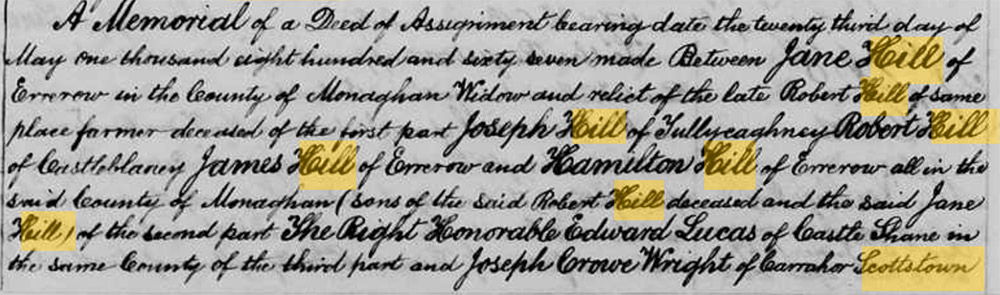
Perhaps the most exciting application of AI for genealogists, the automatic transcription of handwritten documents has continued to develop. The key consideration is that the transcription does not have to be perfect in order to contribute to an indexed dataset that you can then search by keyword. This then offers potential gold dust for genealogists: new sources that would otherwise have remained hidden.

For me, the most impactful implementation of this continues to be FamilySearch’s Full Text search, which is now a permanent fixture in their navigation (rather than a labs experiment that you have to turn on). Every time I find a new Irish townland of interest, I can search for relevant deeds and documents. These documents, previously unknown to me, have the potential to help propel my Irish genealogical timeframe further back.
For those working with family documents or records, there has also been a promising looking third-party effort harnessing low-cost commercially available AI models: Dan Maloney’s OpenTranscribe.
My genealogy work with AI
I’ve only really scratched the surface myself. Most recently:
- I’ve used chatbots to help rationalize some of the meaning I can infer from the 18th and 19th centuries deeds I’ve found via FamilySearch
- The chatbot is able to take my transcriptions, often including identically named people, previous referenced deeds and different townlands, and put together potential hypotheses as to how these people might be related
- Of course, a more skilled historian than me would have been able to do this anyway, but I’ve found this use of AI to help generate hypotheses very convenient
In future I hope to be able to work with AI and DNA, but for privacy reasons I think this will need to wait for self-hosted AI models.
Here are some interesting uses of AI for genealogy I’ve seen this year.
New AI prompted microapplications
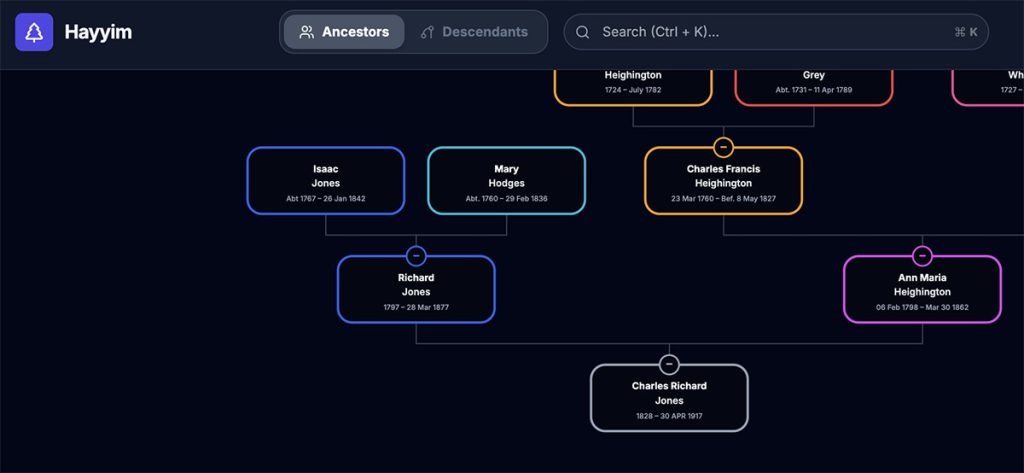
In their highly recommended Family History AI show podcast, Steve Little and Mark Thompson often talk about how non-programmers now have the power to create applications for the community. I saw a pretty amazing one today: in the Genealogy and AI Facebook Group, Benjamin Janiszewski posted a web application he had built using Google Gemini. Benjamin’s app is called Hayyim and does one thing very well: visualizing a GEDCOM file. Your file does not appear to be uploaded anywhere, and is processed in the browser only, allowing you to search for an individual and flip between showing their ancestors or descendants. With the caveat that this is AI-developed software and therefore even the person who created it may not have a detailed idea of how it works, I’d suggest you check it out; it’s really very slick, and provides a quick and simple way to peruse a family tree.
Interesting visualizations
Taking advantage of improved text handling and the photo processing power of tools like Google Gemini’s Nano Banana, Steve Little worked with an idea first posted by Bonnie Bossert in the Genealogy and AI Facebook Group and really ran with it. You can read more about his census visualizations in the blog post. Census records offer us a priceless window into where a person was at a specific point in time. By fusing this information with geographical maps and/or photographs, we can enhance our understanding of these records.
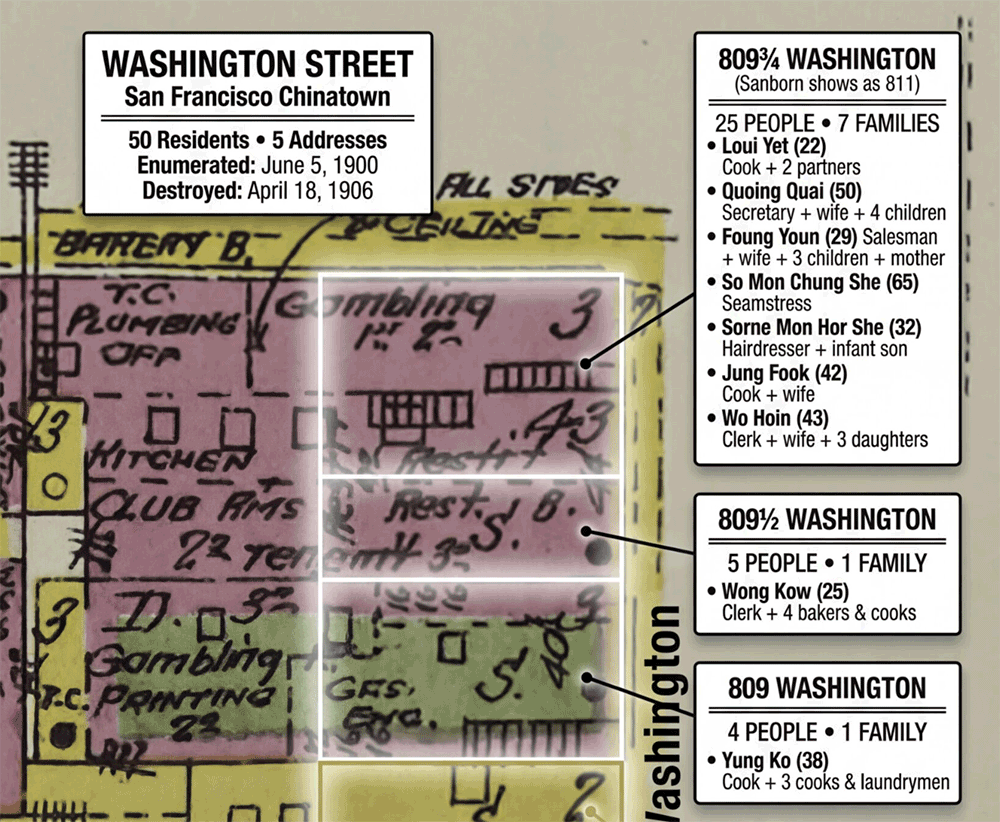
I thought this was a great example of how the creative use of these tools can bring our documents to life in an interesting and genuinely useful way.
Testing company developments
AncestryDNA
The most impactful release in 2025 for me was custom clusters, part of their premium pro tools package. I wrote about this last month. There was also a new ancestry composition update (these tend to blur together for me these days!)
FamilyTreeDNA
The company celebrated 25 years in business this year. As well as implementing two-factor authentication, they announced updates to the Y-DNA Haplotree and mtDNA Tree of Humankind.
23andMe
In an eventful year, 23andMe filed for bankruptcy in March. It briefly looked as if a US biotechnology firm were going to buy it, before the TTAM Research Institute, a non-profit led by former CEO Anne Wojcicki did so with a bid of $305 million. While this offers some security to those worried about their data, it appears sadly that they are pivoting away from genealogy and towards health.
MyHeritage
MyHeritage surprised everyone by announcing that they will process all autosomal tests with whole genome sequencing going forward. They also just announced a traits feature. Arguably their most impactful action this year was the termination of DNA uploads. While this is mitigated somewhat by very low DNA kit prices, it’s not always possible to obtain a fresh DNA sample. They also released updated ethnicity estimates and an ancient origins feature. My favourite new release was Cousin Finder, which is a clever way to find other MyHeritage users that you’re related to (kind of like Theories of Family Relativity but without DNA).
LivingDNA
After an exciting burst of activity in 2023 and 2024, with a chromosome browser and colour coding of matches, Living DNA have had a quieter year. A portal redesign was their main development in 2025. I’m sure I’m not the only genealogist who would welcome some new features, such as user trees. This could transform a platform with potential to one that is genuinely useful.
Investigative genetic genealogy (IGG)
Particularly since the golden state killer case in 2018, the topic of using DNA and genealogy to solve criminal cases has loomed large. It’s a sensitive and divisive issue that evokes strong feelings both from those working to solve cases and others more focused on privacy and informed consent.
Until recently, the debate has focused mostly on DNA testers having consented or not to having their DNA used in these investigations, and the degree to which practitioners and investigators had followed the rules about which databases could be used. But in November it was reported that Ancestry had closed the account of the Investigative Genetic Genealogy (IGG) Center at Ramapo College due to their use of the site’s records and tree building tools in cold case investigations.
Ancestry then clarified their position, stating “Our stance has been clear and consistent for years: Ancestry does not allow our services to be used for law enforcement investigations unless we are legally required to comply.”
This puts the important and rapidly growing field of IGG in a difficult position going forward. Jarrett Ross had a discussion about this with Cairenn Binder on his GeneaVlogger YouTube channel. While I can understand those who feel genealogists should be free to follow their hobby without having to think about law enforcement, it does seem a shame that practitioners will no longer have access to Ancestry’s tree building and hint tools. I hope all parties can settle on some kind of licensing agreement.
DNA Painter
I launched the new Places functionality in February, followed by the matrix tool in May, followed by some rapid iterations. It was great to be able to respond to user feedback and make the tool better. Some AI assistance also speeded this process up. As a long-time developer, using AI is something I’m taking slowly, but I’m very grateful that it’s there. Unfortunately the second half of the year was dominated by bereavement, but I did create an update log page for smaller releases. The most recent of these was a French translation of the Shared cM tool.
Plans for 2026
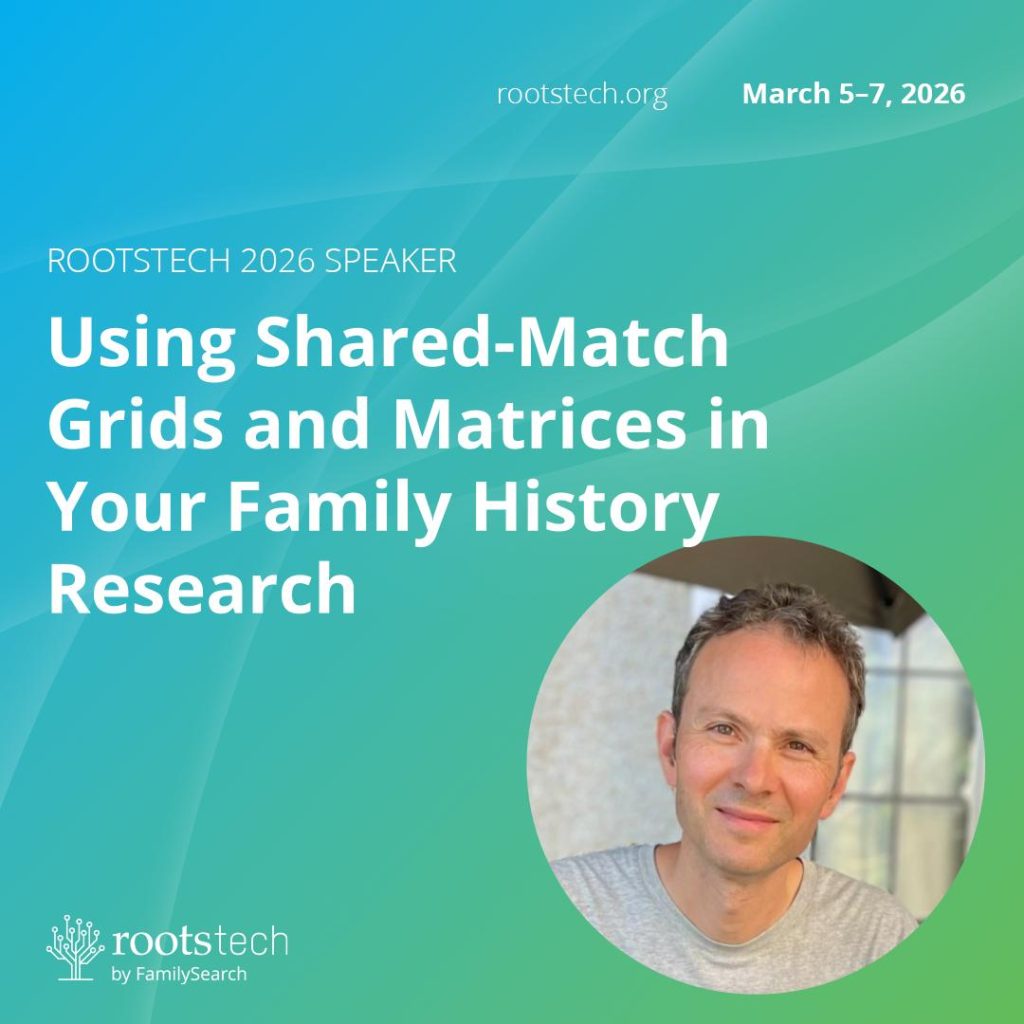
Next year I’ll be speaking quite a bit, including a talk at RootsTech 2026 in Salt Lake City and a webinar for Legacy Family Webinars. I’ll also be doing an interview with Cathie Sherwood’s Family History Academy
I’m also looking forward to releasing some interesting and hopefully exciting new developments for trees and chromosome maps. My goals haven’t really changed: I hope to continue developing tools and features that are user-friendly and which help genealogists to visualize their family history and DNA matches in new and revealing ways.
Wishing you all the best for 2026!
Top ‘2025’ image made using this code example by Johan Karlsson
Contact info: @dnapainter.bsky.social / jonny@dnapainter.com